The Hidden Danger Awaiting Amateur Sailors
Essential Safety Warnings Every Recreational Boater Must Know
In the news we published on our site on April 24, 2020, we reported that the DAU application replaced the Blue Card
“BLUE CARD IS GONE, DAU HAS ARRIVED” under this headline.
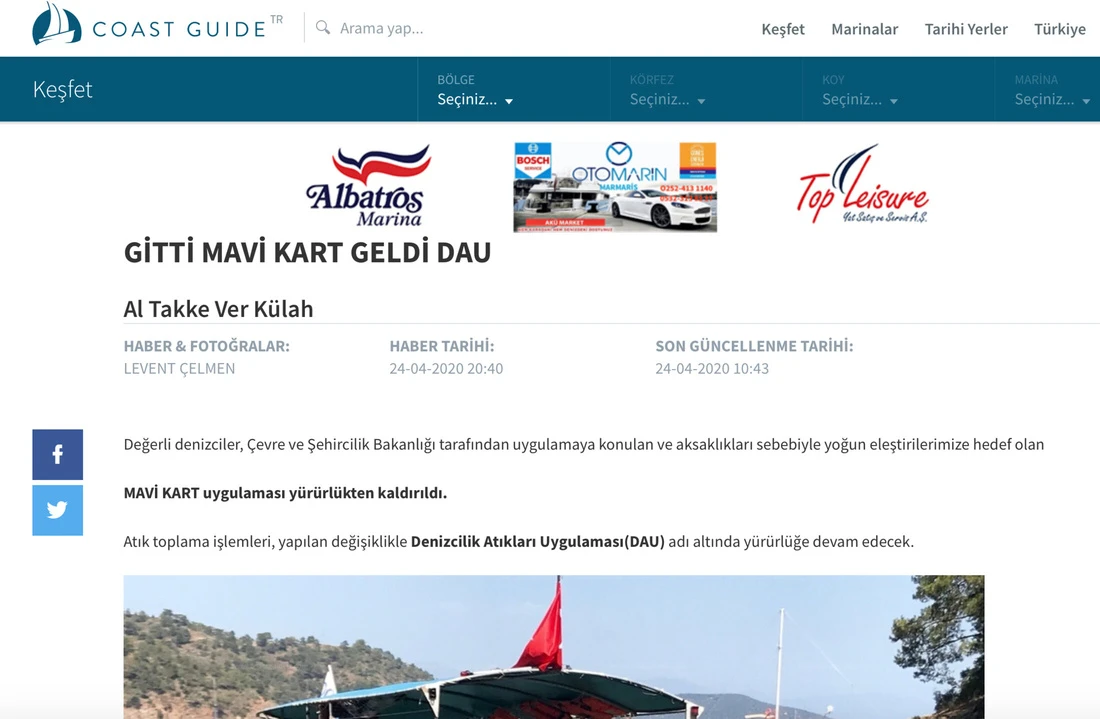
In the content of our news, we wrote that these name changes did not eliminate the grievances experienced by Amateur Mariners.
This summer season, a season was experienced where SG Boats generally did not pressure amateur vessels much regarding the issue.
The reason for this was that an amateur mariner appealed the penalty he was subjected to through the court.
With this appeal, it revealed that due to the regulatory gaps in the circular, penalties could not be issued, and even if issued, their collection was legally difficult.
Given the situation, a calm season was experienced.
While the season passed calmly, those who prepared the regulations signed a new circular by closing the gaps that were objected to.
On September 02, 2020, the circular prepared by the Ministry of Environment and Urbanization was published.
Sensitive mariners regarding this issue began to try all individual avenues.
While some deepened their research and informed other mariners, others took the matter to legal channels.
We covered these actions in detail in our news.
Again, Small Vessels and Ships are treated the same in terms of regulations and penal applications will be applied identically.
Now let's look at what awaits small vessels, which are treated the same as Ships, in the upcoming season:
MANDATORY WASTE DELIVERY EVERY 15 DAYS
Small boats are now required to dispose of waste every 15 days after leaving the port.
“I'm staying in the bay, I've been tied to the dock for days” is no longer acceptable.
Solid waste will also be brought under control. No more disposing in municipal containers or at dock restaurant waste collection units.
You will carry it with you for 15 days and hand it over with a receipt at a facility that accepts waste.
WASTE TO BE DELIVERED TO WASTE RECEPTION FACILITIES WITH RECEIPTS
It doesn't matter that it smells for days, produces bacteria, etc.
Hand over your waste with a receipt and according to the tariff determined by the reception unit.
Waste receipt forms must be kept on board.
RESPONSIBILITY TO KEEP FORMS HAS ARRIVED
If you don't keep these forms, don't show them…
Well, does the state, which covers all loopholes with its issued circulars, fulfill its own duties on this matter?
Meaning?
ARE WASTE RECEPTION FACILITIES AND BOATS SUFFICIENT ON OUR COASTS?
Can it put waste reception facilities into operation at reasonable intervals along our coasts?
Which of us doesn't wait for hours off the marina for our turn?
What is the financial criterion for receiving these wastes? Will anyone who wants charge whatever they want?
IS THERE A WASTE RECEPTION TARIFF?
Will it ensure and supervise that these fees are reasonable and sufficient to cover the facility's operating costs?
Isn't the main point to collect these wastes without loss and without creating excessive cost burdens?
If these stations aren't being established, don't the waste reception boats need to increase their numbers to match the service demand?
It's currently known how difficult this process is.
Pretending to have done it, pretending to be implementing it…
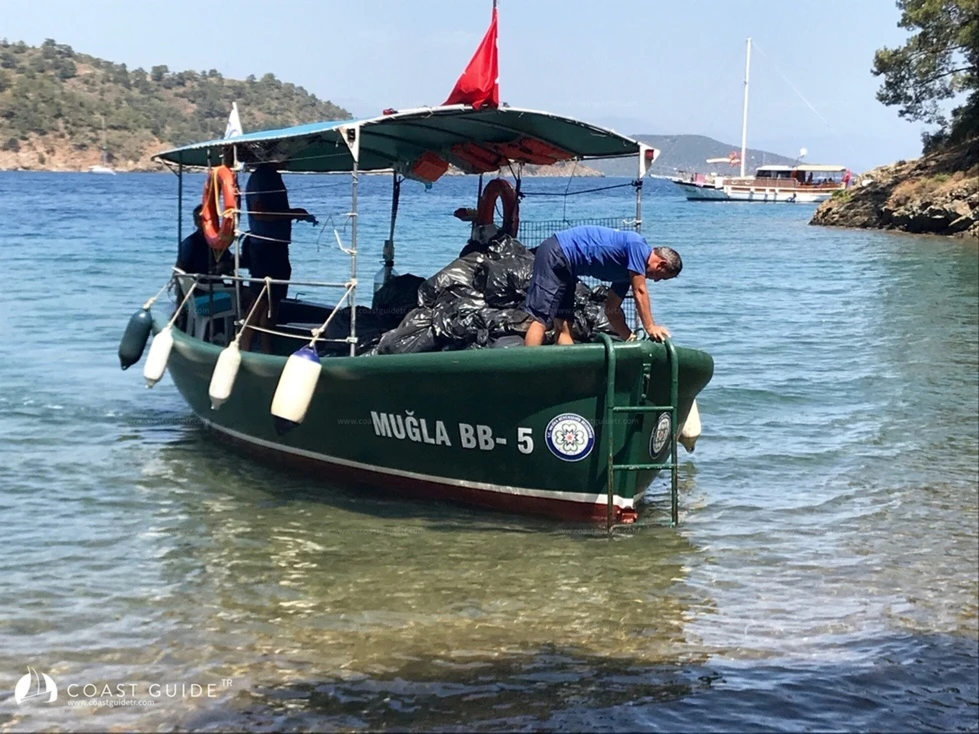
DOES A SAILOR WANT TO LIVE IN DIRTY WATERS?
Which sailor wants to pollute the seas where their children swim. Aren't sailors the first ones to stand against this pollution?
Well, do you have enough treatment facilities in your coastal cities and towns?
If you do, are you using sufficient chemicals and performing treatment at the desired efficiency?
If you say we do it, we supervise it, we ask;
WHAT ARE YOU DOING ABOUT LAND-BASED WASTE DISCHARGED INTO THE SEA?
What are those smells that reach our noses after midnight off Turgutreis, off Tunç, off Marmaris, off Kemer and in dozens of places?
Are small boats doing this?
What you are doing about land-based waste that you cannot control and that is released into the seas, what measures you are taking is a matter of curiosity.
THE FOREIGN YACHTSMAN FLED
Will foreign yachtsmen who have moved away from our seas as a result of these and similar incomprehensible sanctions come back?
What if you drive away from the sea those who bought boats thinking they would find peace at sea, those who went out to sea, with these decisions?
What about the goal of "increasing the number of Turkish flagged boats on our coasts, in World Seas".
Is this how?
As we increase...
Let's look at the initiatives of our valuable yachtsmen on this matter.
YÜCE UYANIK
As you know, I have been conducting some studies for approximately five years in order to demonstrate the incorrectness of targeting amateur sailors living at sea, who show the greatest sensitivity on this matter, in efforts made to prevent marine pollution, and to emphasize the damage it causes.
The most recent Marine Waste Implementation Circular published on 2 September 2020 was also prepared with good intentions but without considering the conditions and approaches of amateur sailors, which revealed some contradictory situations.
While amateur sailing associations preferred to do nothing on this matter and to get involved if a problem arose, İzmir Güzelbahçeli Amateur Sailors, under the presidency of Av. Murat Sezmiş, filed a cancellation lawsuit at the Council of State.
I also applied to Cimer to confirm the evaluations and inferences I made on this matter.
My application made on 18.11.2020 to the T.C. Presidency Communication Center (CİMER) was answered on 03.12.2020 (obviously after research, 45 days later) by the Ministry of Environment, ENVIRONMENTAL MANAGEMENT OF MARITIME ACTIVITIES BRANCH DIRECTORATE on 03.12.2020.
QUESTION 1
Does the term "commercial vessels subject to MKS, vessels used for sporting and recreational purposes, and fishing vessels" in Article 6 "(3)" also cover private / amateur boats?
Although this is not explicitly written, it is observed that Coast Guard units also evaluate private boats within this scope.
The matter needs confirmation.
ANSWER 1
The 3rd paragraph of Article 6 of the circular also covers private vessels.
QUESTION 2
According to which document will the passenger carrying capacity be determined exactly?
(For example, there is no such information in our vessel's mooring log license)
ANSWER 2
In determining the passenger carrying capacity, documents issued in accordance with the Technical Regulation of Ships and relevant legislation must be taken as basis.
QUESTION 3
Due to differences in knowledge and understanding regarding the legislation on private vessels, some institutions may consider all the time that private vessels are outside the marina as “time at sea”.
This situation may create differences in how inspection personnel calculate the duration regarding the relevant obligation.
Therefore, the answers to the following questions are important:
What does the term “navigation” define in the following situations?
ANSWER 3
In the aforementioned circular, navigation refers to the period from when the vessel departs from a coastal facility to which it is moored until it is moored at another coastal facility.
Comment on Answer 3
“Navigation” is a critical term here. Its explanation has been made. The term “Coastal Facility” mentioned here becomes important. Let's look at that as well:
Coastal facility, under the scope of the Coastal Law No. 3621 dated April 4, 1990, refers to facilities such as ports, cruise ports, marinas, passenger terminals, quays, piers, berths, fuel or liquefied gas pipeline buoys or platforms, fishing shelters, ship recycling facilities, shipyards, boat construction and slipway sites that can be constructed on areas reclaimed through filling and draining on coasts, as well as other permanent facilities adjacent to them, other infrastructure or superstructure facilities for maritime transportation, and structures such as buoys, lighthouses, groins, coastal barriers, discharge lines, submarine cables, offshore platforms and similar structures.
In other words, when waste generated during navigation is mentioned, for amateur vessels it refers to the period from leaving a marina or fishing shelter until returning to it. Restaurant piers are ambiguous. As several Coast Guard commanders I spoke with stated that such piers are not considered coastal facilities.
Let's Review Article 6 Again:
“Article 6 "(3) Commercial vessels subject to MARPOL, vessels used for sporting and recreational purposes, and fishing vessels,
a) "Those with a transport capacity of less than 12 people including passengers and personnel, are obliged to deliver their sewage and garbage generated during navigation to a waste reception facility or waste collection vessel at least once every fifteen days."
b)"Those with a transport capacity of 12 people or more including passengers and personnel, must deliver their sewage and garbage; within 48 hours following the day they return to port after completing their operations following departure from port; if they depart on another voyage within 48 hours, they must deliver these wastes to a waste reception facility or waste collection vessel before the voyageare present."
Private boats, according to the regulations, can carry a maximum of 12 people. This definition is necessary for all of us:
Private Boat:
In the “Ship Type Definitions for Ship Registry” guide published by the Ministry of Transport, Maritime Affairs and Communications, General Directorate of Maritime and Inland Waters Regulation, private boats are defined in the 38th section.
In this section, private boats are divided into: private yacht, private speedboat, dinghy and amateur fishing boat.
Private Yacht:
Built in yacht type, having cabins, toilets, sinks, galley, carrying no more than 12 passengers, used for excursion and sports purposes, used as a private yacht and not exceeding 24 meters in length when measured according to national standards.
Therefore; if we leave the marina with our private yacht and do not stop at any coastal facility afterwards, and if our boat has a carrying capacity of 12 people or more, and if there are fewer than 12 people on board (including 12), we must deliver our waste and garbage within 48 hours after returning to the marina (whenever we return).
But if we have a boat with a written capacity of fewer than 12 people (excluding 12), then we must deliver waste and garbage once every 15 days.
Otherwise, the penalty is 24,123 TL.
QUESTION 4
Private boats normally dispose of their garbage in municipal containers of nearby settlements at most every 2-3 days under normal conditions. From this circular, the conclusion emerges that garbage will also be accumulated and given to waste reception facilities every 15 days in exchange for a document. Is this really correct?
ANSWER 4
In accordance with the Regulation on Waste Reception from Ships and Control of Waste, the principle is that every waste produced on board a ship must be delivered to the waste reception facility with a waste transfer form to be issued via the DAU. There is no regulation regarding the accumulation of waste to be given every 15 days.
Answer 4 Commentary
Throwing your garbage into municipal containers has no meaning in terms of the DAU. If you cannot document that you have given garbage with a Waste Transfer Form at most every 15 days, your penalty for 2021 is 24,123 TL. (For example, some marinas allegedly charge 5 Euros per garbage bag.)
QUESTION 5
If the answer to Question 3 is given as the period of leaving and re-entering the coastal facility, according to paragraph (b), this time it will mean that private vessels with a passenger and crew capacity of over 12 people will deliver waste within the following 48 hours (that is, once a year) when they return to the marina after leaving the marina and cruising for 5-6 months.
In any case, this situation creates a significant contradiction for two boats of different sizes with 1-3 people on board.
ANSWER 5
According to the Environmental Law, Water Pollution Control Regulation, Regulation on Waste Reception from Ships and Control of Wastes and relevant legislation, it is prohibited to discharge wastes originating from ships directly and/or indirectly into the marine environment in a manner that would harm the environment; the principle is that these wastes must be delivered to waste reception facilities and/or waste reception vessels.
The article in question regulates the procedures regarding the vessel's waste delivery during entry and exit from coastal facilities.
Answer 5 Comment
We made the comment above. It is not said that there is no contradiction. This response is another proof that private vessels lived aboard at sea are being overlooked.
QUESTION 6
If a 10 GT private vessel and a 100,000 GT tanker cannot present the waste transfer form during inspection, what will be the sanctions imposed on both?
ANSWER 6
Article 12 of the Environmental Law regulates the obligation to present information and documents; this article does not contain any regulation regarding the dimensions of vessels.
Pursuant to paragraph (g) of Article 20 of the Environmental Law, an administrative fine of 22,109 Turkish Lira is imposed on those who fail to fulfill the notification and information provision obligation stipulated in Article 12 of the Law.
Answer 6 Comment
We were right to be concerned. The same amount of penalty for both a 100,000 Gross ton tanker and a 2 gross ton 3 meter boat: 24,123 TL.
QUESTION 7
Waste reception facilities have increased waste reception fees excessively, especially after the issuance of this circular.
Is there any work by the ministry regarding making this process free of charge or setting a ceiling fee for private boats?
ANSWER 7
In Article 26 of the Regulation on Collection of Waste from Ships and Control of Waste, services to be provided by waste reception facilities and waste collection vessels must be carried out in return for a fee to be collected from ships.
The fee tariff to be collected from ships is determined by the Ministry, taking care to ensure it is fair and transparent in order to ensure maximum collection of waste.
Pursuant to this provision, the "Communiqué on Fees and Principles to be Applied within the Framework of the Regulation on Collection of Waste from Ships and Control of Waste" was published in the Official Gazette dated June 5, 2009 and numbered 27249.
The pricing of services provided for waste collection from ships must be carried out within the framework of the procedures and principles specified in the aforementioned Communiqué.
In case a complaint/notification/report is made to our Ministry or to the Provincial Directorate of Environment and Urbanization in the province where the shore facility is located regarding a waste collection obligor that is assessed to have made pricing outside the procedures and principles of the Communiqué, necessary inspections will be conducted.
Comment on Answer 7
The regulation based on tonnage calculation for large ships' waste disposal, which was made in 2009 when the Blue Card application did not exist, is still being attempted to continue on a Euro basis
(despite the Presidential Decree stating that foreign currency shall not be used).
If there is no one on private boats or if needs are met outside the boat, they will be forced to deliver perhaps symbolically 1 liter of waste once every 15 days.
When the system continues without establishing a fee infrastructure and without considering private boats, we also encounter distorted practices.
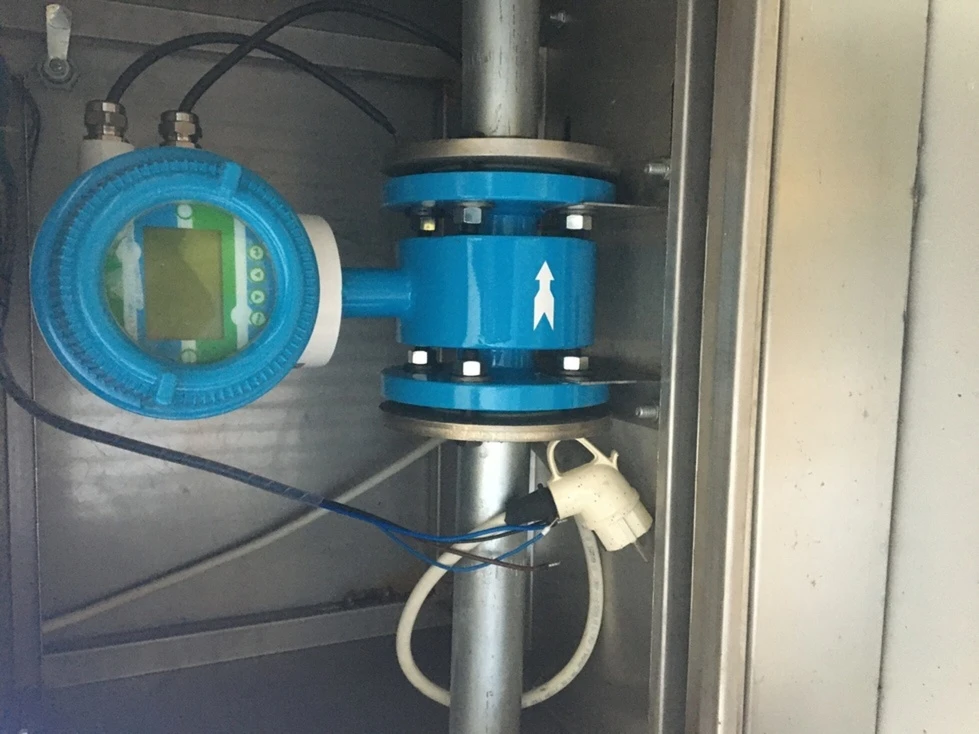
Amateur Mariner Attorney Murat Sezmiş and many sailors have preferred to seek legal remedy for the contradictions they identified regarding the matter.
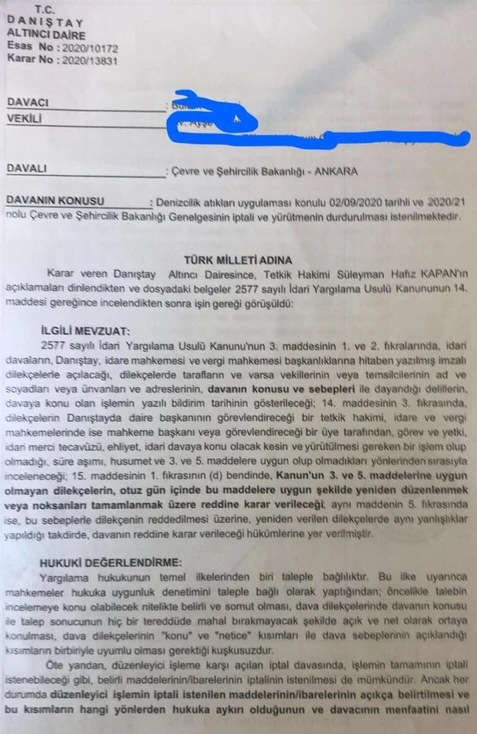
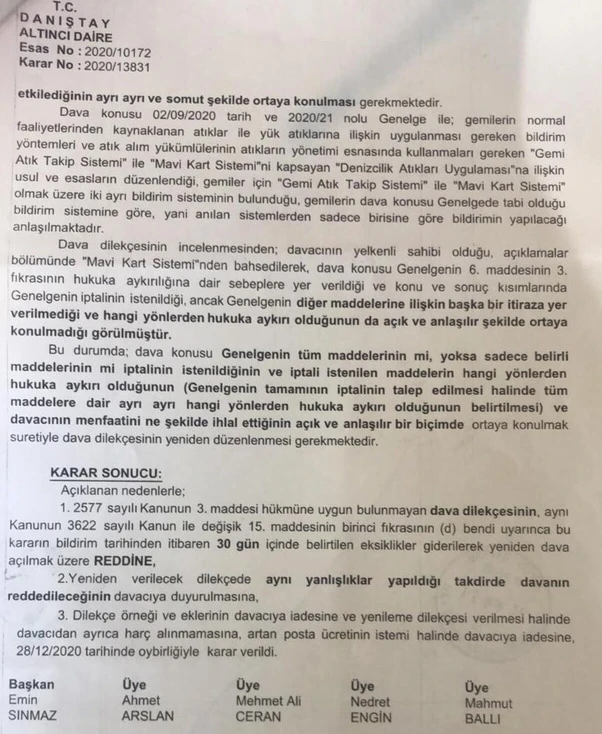
The cases are being heard at the Council of State 6th Chamber.
MURAT SEZMİŞ
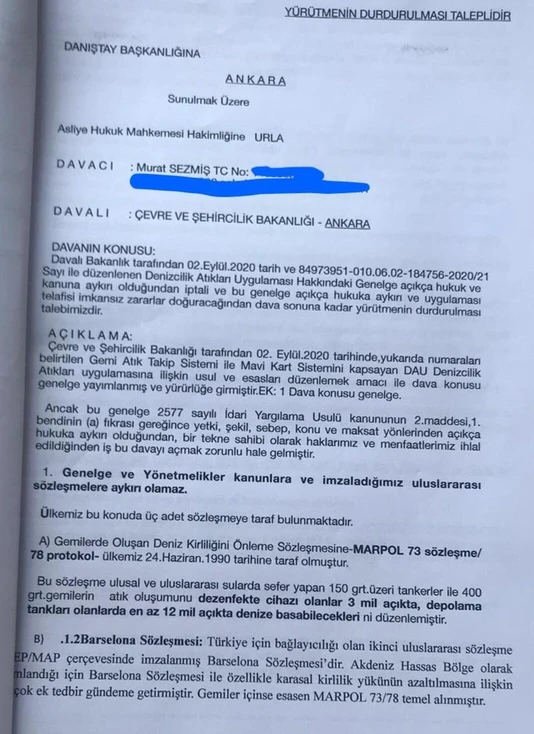
However, the responses coming from the Council of State 6th Chamber these days to our sailors who preferred this path and filed lawsuits are as follows.